
Retail chains spend significant money on store design, window displays, social media campaigns and loyalty programmes. Then they hand their staff a polo shirt with a logo on it and consider the brand experience complete. It is not. The person wearing that shirt is your brand in motion — the thing every customer actually interacts with, remembers and forms an opinion about. If the uniform communicates nothing beyond “I work here,” you have missed the most direct and continuous brand touchpoint you have. This article is about what to do instead.
Before the Product, Before the Price — There Is a Person
Think about the last time a retail experience genuinely impressed you. Somewhere in that memory, there is almost certainly a person — someone who knew their product, was warm without being scripted, and felt like they belonged to the brand they were representing. The physical store was the stage. They were the performance.
Research on retail customer experience consistently shows that human interaction is the primary driver of how customers rate their in-store experience. Not the layout, not the lighting, not the music — the people. A study by the Harvard Business Review found that customers who had the best past experiences spend 140% more than those who had the poorest. And the most significant driver of that experience quality? Staff interaction.
Your staff uniform is the opening frame of that interaction. Before a word is spoken, before a product recommendation is made, before any warmth or knowledge is demonstrated — the customer has already registered an impression from the person standing in front of them. That impression is partly formed by what they are wearing. Treating the uniform as a functional necessity rather than a brand statement means losing that first impression every single time.
What a “Dead” Uniform Actually Costs
A dead uniform is one that communicates nothing except employment. It is a logo on a plain shirt, usually in the brand’s primary colour, usually in a fit and fabric that nobody would choose voluntarily. Staff wear it because they have to. Customers notice it only well enough to identify who works there. It does no active work for the brand at any point in the day.
The cost of this is harder to quantify than a marketing budget line, but it is real. Staff who feel uncomfortable or uninspired in their uniform carry that into their posture, their energy and the way they approach customers. This is not speculation — it is the documented “enclothed cognition” effect, established in research by Adam and Galinsky at Northwestern University: what people wear affects how they think and behave, independently of how others perceive them. A staff member who feels good in what they are wearing approaches the shop floor differently from one who is tolerating it. That difference reaches every customer they interact with.
There is also a retention dimension. In retail, staff turnover is one of the largest operational costs, and the factors that drive it are often subtle. Feeling valued by an employer — through training, environment, and yes, the quality of what you are asked to wear — consistently appears in research on retail employee satisfaction. A uniform that signals low investment by the employer is a small but steady signal in the wrong direction.
“Every hour your store is open, your staff are carrying your brand. The question is whether what they are wearing is helping that or just covering their torso.”
The Uniform as a Living Touchpoint
A well-designed retail staff uniform is not just clothing. It is a communication channel that is active every minute the store is open, in direct proximity to every customer who enters. No other brand element operates at that proximity and frequency simultaneously.
Consider what a uniform can communicate beyond “I work here.” It can convey the values your brand holds. It can signal the quality level you operate at. It can reference the story of why your brand exists. It can invite curiosity, communicate warmth, or project confidence and expertise. All of this happens in the first seconds of a customer encounter, before language, before product knowledge, before any deliberate interaction takes place.
The brands that understand this — and there are some, particularly in premium retail — invest in their uniforms the way they invest in their store design. They brief designers. They consider colour psychology. They think about what the garment communicates on a person moving through a store environment. They produce something that reflects the same level of thought as their visual identity, their packaging and their brand guidelines. They treat the uniform as part of the brand rather than a practical afterthought.
The brands that do not understand it — the majority of mid-size retail chains — leave this touchpoint entirely to chance.
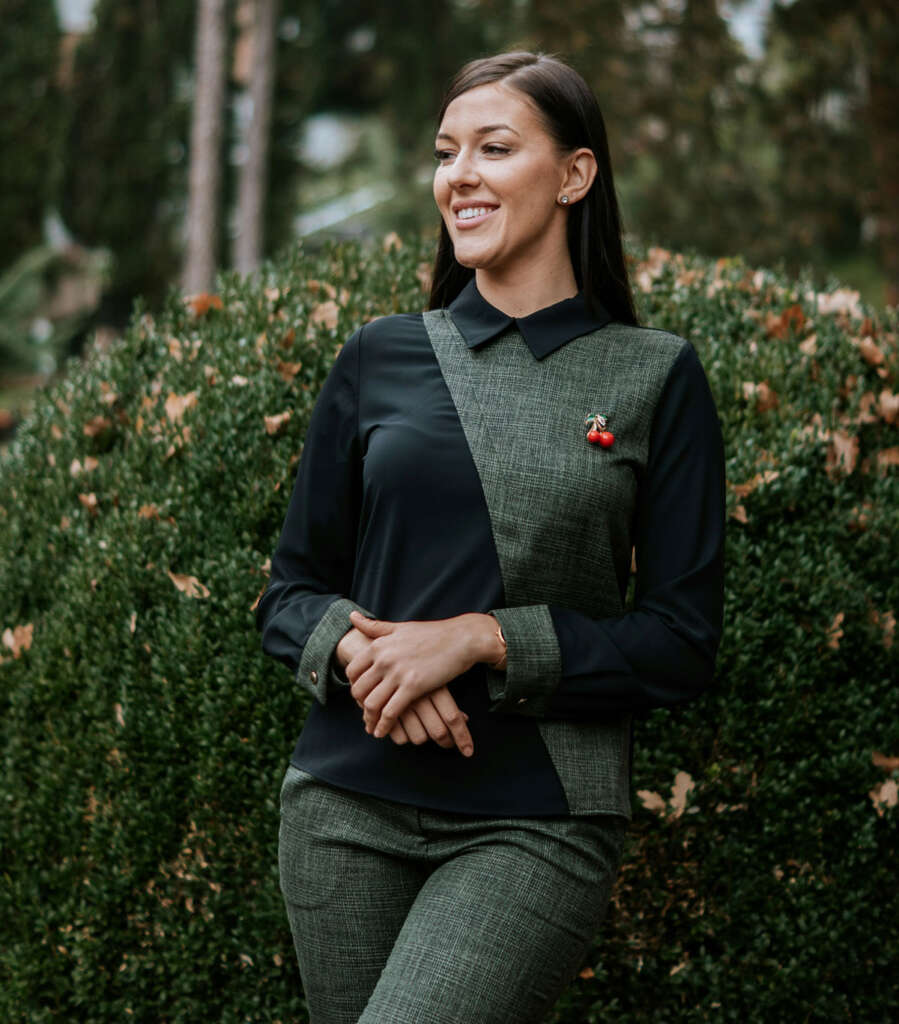
Design That Makes Your Staff Want to Wear It
The single most important shift in how retail chains approach uniform design is this: design it for the person wearing it, not for the brand that wants to be represented. When those two things are aligned — when the design genuinely serves both the wearer and the brand — the uniform works. When only one of them is served, it fails.
What does designing for the wearer mean in practice? It starts with fabric. A staff member who spends eight hours on their feet, bending, reaching, moving constantly, needs a garment that feels good at hour seven as much as hour one. Heavy, stiff fabrics that look fine at 9am look and feel exhausted by the afternoon. A polo shirt in a considered fabric weight — 220–240 GSM, ring-spun cotton — feels and looks better at the end of the shift than a cheaper alternative does at the start of it. That difference is visible to customers and felt by the person wearing it.
Fit matters enormously. A generic unisex shirt in male proportions does not flatter most bodies and communicates nothing about quality. A considered fit — genuinely designed to work across body types, with appropriate length, shoulder placement and ease of movement — produces a completely different visual impression and a completely different wearing experience. Staff in well-fitted uniforms carry themselves differently. This is not vanity; it is the same psychology that makes a well-tailored suit feel different from an ill-fitting one.
Colour deserves more thought than most retail chains give it. The instinct is to use the brand’s primary colour, and sometimes that is the right call. But if your brand colour is a saturated primary that is genuinely unflattering on most skin tones, it is worth exploring whether a muted or slightly shifted version of the same hue serves both the brand and the wearer better. Colour that makes staff feel attractive and confident is not a trivial consideration — it affects the energy they bring to every customer interaction.
The Conversation Starter — Your Uniform as an Icebreaker
This is the angle that most retail chains never consider, and it is potentially the most valuable one. A uniform designed with an interesting, specific, or witty element gives customers a natural and genuine reason to start a conversation with staff. Not “excuse me, can you help me” — a transactional opener — but something warmer and more human.
The principle is simple. People comment on things they find interesting. If your staff uniform has something worth noticing — a clever phrase, an illustration that tells a story, a detail that reflects something specific about the brand — customers will notice it and comment. That comment opens a conversation. That conversation is the beginning of a relationship between a customer and your brand that no advertisement can replicate.
Picture This
A customer in a specialty coffee chain notices the back of a staff member’s apron carries a small illustration of the farm where the chain sources its beans, with the farm’s name and altitude printed beneath it. They ask about it. The staff member tells them the story of the farm, the relationship with the grower, the flavour profile of the current season’s harvest. The customer learns something, feels something, and buys differently. None of that conversation would have started with a plain apron bearing a logo.
This works across retail categories. A bookshop whose staff wear shirts with a sentence from a book the brand considers essential — changed seasonally — creates a recurring reason for regular customers to notice and interact. A sports retailer whose team wears a performance-related phrase that reflects the brand’s philosophy gives customers something to ask about that is directly relevant to why they are in the store. A pharmacy chain whose staff wear a garment that references the brand’s founding principle creates a human connection to a brand that customers might otherwise experience as generic.
The design element does not need to be large or obvious. It can be a small illustration on the sleeve. A typographic treatment on the back. A phrase on the collar. An interesting choice of colour or detail that invites a second look. What it needs to be is genuine — connected to something the brand actually believes or does, not a decoration applied because it seemed interesting. Customers can tell the difference, and so can staff.
Telling Your Brand Story Through the Uniform
Every retail brand has a story — a reason it exists, a value it holds, a community it serves. Most of that story is communicated through marketing materials, packaging and social media. The uniform is rarely part of the narrative. It should be.
The question to ask when briefing a uniform design is: what is one true thing about this brand that a customer would find interesting or valuable to know? Not a marketing claim. A true thing. The year the brand was founded and why. The place it came from. The product it is most proud of. The principle it will not compromise on. That true thing is the starting point for design that communicates something real, rather than design that just presents a logo.
A food retailer that has been sourcing from the same regional farms for thirty years could reference those farms in the uniform design. A fashion chain built on a specific aesthetic principle could make that principle legible in the garment itself. A health and beauty retailer with a genuine commitment to ingredient quality could use that as the design language. In each case, the uniform stops being a functional identifier and becomes a piece of the brand’s ongoing conversation with its customers.
This approach also has an internal effect that is easy to underestimate. Staff who understand and can tell the story behind their uniform are more engaged with the brand they represent. The uniform becomes something they feel connected to rather than something they comply with. That engagement is visible on the shop floor, and customers feel it in every interaction.
The Instagram Dimension
Retail happens in physical space, but its impression increasingly extends into digital space through the content customers create and share. A store that is visually interesting gets photographed. A staff member in a genuinely striking or beautiful uniform gets photographed. That image travels.
This is not a reason to design a uniform primarily for social media impact — the in-person experience always comes first. But it is a reason to consider whether your current uniform has any visual quality that a customer would find worth capturing. Most do not. A logo on a polo shirt is not content. A well-designed garment that tells a story, uses an interesting graphic or combines colour in a way that photographs beautifully is content, and it generates brand impressions with audiences that no other element of your in-store experience reaches.
The brands most successful at this treat their retail environment — including their staff’s appearance — as a designed visual space. Everything in frame is considered. The result is an environment that customers want to document and share, which extends the brand’s reach into social networks at no additional cost.
Functional Design for Active Retail Work
All of the above means nothing if the garment does not work for the job. Retail staff are on their feet for long periods, moving constantly between stockroom, shop floor and customer interactions. The uniform needs to accommodate that movement comfortably, maintain its appearance through a full shift, and survive repeated laundering without degrading quickly.
Pockets are almost universally underspecified in retail uniforms. A staff member who needs somewhere to put their phone, a pen, a small notepad or their personal items during a shift — but whose uniform has none, or only decorative ones — is being failed by the design. Functional pockets in the right positions, accessible when moving and not visually disruptive when empty, are a design consideration worth raising explicitly with your supplier.
Layering matters in retail environments where temperature varies — between the shop floor, the stockroom and any outdoor areas. A core uniform piece that layers cleanly with an outerwear option, both branded consistently, gives staff flexibility without visual inconsistency. A staff member who has to wear their personal jacket over the uniform because there is no branded option breaks the visual identity of the team in a way that is entirely preventable.
The Brief Before the Brief
Before you approach a supplier or designer, it is worth spending time on the questions that will make the design brief actually useful. What do you want customers to feel when they first see your staff? What is one true thing about your brand that is not currently communicated anywhere in the store experience? What do your staff say when you ask them what they dislike about the current uniform — and what would make them proud to wear it? What does the uniform look like at the end of a busy Saturday, and is that acceptable?
These questions produce a brief that goes well beyond “polo shirt in brand colour, logo on chest.” They produce a brief that a designer or a quality supplier can work with to create something that does real work for your brand — in every customer interaction, every shift, every day your stores are open.
Your staff are the most present element of your brand experience. The uniform they wear is the most continuous visual expression of your identity. Design it with the same intention you bring to everything else, and it will return that investment in ways you will feel in customer interactions, staff energy and the slow, steady accumulation of brand impressions that no campaign can replicate.
Custom Apparel Istanbul
We work with retail chains across Europe to design and produce staff uniforms that go beyond the logo — considered design, premium fabrics, Pantone-matched colours and private label finishing. From 20 pieces per style, shipped EU-wide in 10–14 days. Get a Free Quote →

