Few garments in a closet get less thought and more use than the hoodie. It’s the piece people reach for without deciding to, the one that’s comfortable enough to sleep in and, on the right person, sharp enough to read as a power move. Design curator Paola Antonelli, speaking for TED-Ed’s “Small Thing, Big Idea” series, calls objects like this “humble masterpieces” — things so well designed that we stop noticing the design at all.
The hoodie earns that title. But it’s also something rarer: a piece of clothing that has meant almost opposite things to different generations, sometimes at the same time.
Older Than You’d Guess
Hooded garments go back much further than casualwear history usually admits. Antonelli traces the earliest recognizable ancestors to ancient Greece and Rome, long before anyone called them hoodies. Through the Middle Ages, the hood shows up on monks, sewn into cape-like robes worn as part of religious life. By the 1600s, the hood had taken on a very different job: some accounts describe women in 17th-century Europe pulling up a hood to conceal their identity on the way to meet a lover — an early, literal use of the hoodie’s most enduring trait, anonymity.
That same anonymity gave the hood a darker set of associations too. Long before streetwear, the hooded silhouette was already tied to the grim reaper and to the executioner — figures defined by having their identity hidden. It’s worth sitting with that for a second: the hoodie has been read as suspicious or sinister for centuries, well before it had anything to do with sportswear or hip-hop.
Born in a Sweater Mill
The hoodie most of us actually wear today — cotton jersey, an attached hood with a drawstring, often a front pocket — has a much more specific origin. It was developed in the early 1930s by the Knickerbocker Knitting Company, a sportswear maker founded in Rochester, New York in 1919 by Simon Feinbloom and his sons. The company, which had already built a reputation making heavy-duty sweatshirts for the University of Michigan’s athletic teams, added a hood to protect laborers working outdoors through cold weather — reportedly workers in cold-storage warehouses and tree surgeons were the ones asking for something warmer than long underwear. The company would later become a household name: Champion.
The design succeeded for the most practical of reasons. It was warm, it was durable, and it let the wearer move freely — which meant it spread quickly from athletes to laborers of every kind. That utilitarian core is exactly why the hoodie has been so easy to reinvent every few decades since.
From Function to Subculture
By the 1980s, the hoodie had picked up an entirely new audience. Hip-hop artists, B-boys, and early skateboarders adopted it as a uniform, and it became closely tied to youth street culture in a way it had never been as sportswear. Part of the appeal was practical — it was comfortable and suited to being outside for hours — but part of it, again, was that same quality the hoodie has carried since the 1600s: the option of anonymity when you wanted it.
Then came a stranger shift. When Mark Zuckerberg showed up to investor meetings in a hoodie, it wasn’t read as sloppy — it became a symbol of a new kind of power, one that didn’t need to perform authority through a suit. As Antonelli puts it in the talk, in a room full of businesspeople, “the real powerful person is wearing a hoodie with a T-shirt and jeans.” The garment that once signaled labor, subculture, or anonymity was suddenly signaling that you had enough power not to bother dressing for anyone.
A Garment That Became a Protest
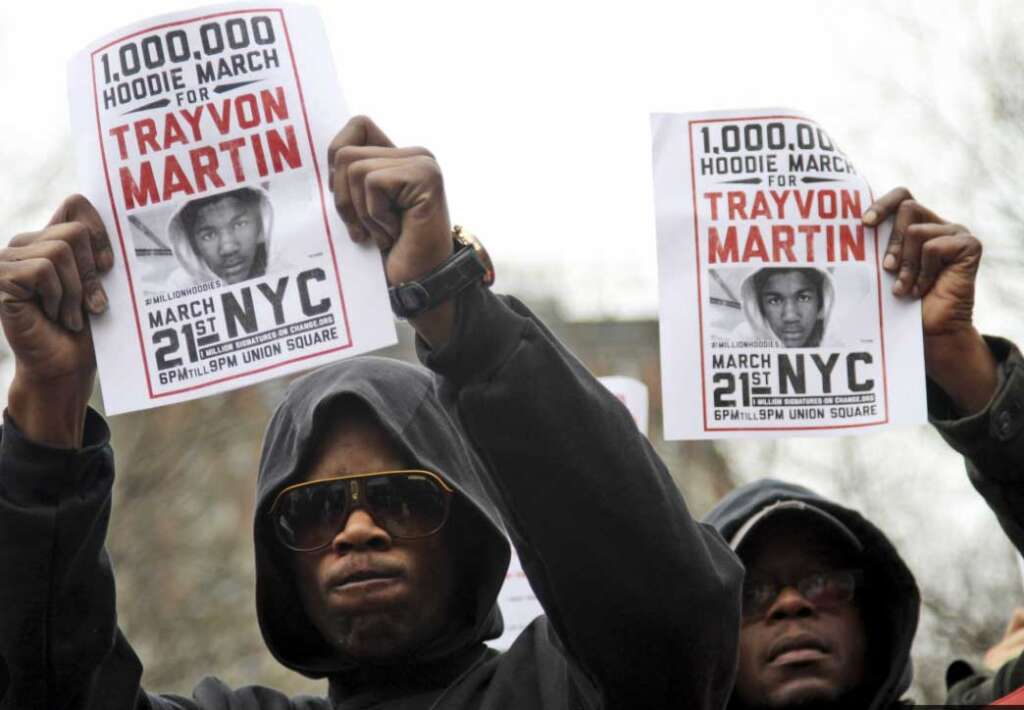
No account of the hoodie’s cultural weight is complete without acknowledging its most painful chapter. In February 2012, 17-year-old Trayvon Martin, an unarmed Black teenager, was fatally shot in Sanford, Florida, while wearing a hoodie. Weeks later, on March 21, hundreds of demonstrators gathered in New York’s Union Square for what became known as the Million Hoodie March, with similar marches following in cities across the United States. Protesters wore hoodies with the hood up, deliberately reclaiming the exact image that had been used to cast suspicion on Martin, and turning it into a symbol of solidarity and protest against racial profiling.
It’s a stark reminder of how much meaning a simple garment can absorb. As Antonelli notes in her talk, it doesn’t happen often for a piece of clothing to carry this much symbolism while still functioning as something people put on without a second thought.
Why the Psychology Sticks
Part of what makes the hoodie unusual is that its emotional effect is almost as strong as its physical one. Pulling the hood up doesn’t just block wind — it creates a sense of retreating into a private space, of building a soft shell between yourself and everyone around you. That’s a big part of why the hoodie shows up in such different contexts: it can mean comfort, protection, rebellion, mourning, or quiet power, sometimes all in the same photograph.
What This Means for a Basic Wardrobe Staple
For a garment this loaded with history, the hoodie remains, at its core, a genuinely simple piece of construction — a jersey body, an attached hood, a drawstring, maybe a pocket. That’s exactly why it belongs at the center of any basics collection. It photographs well, it fits nearly every body and brand identity, and unlike more complex garment types, it rewards good fabric and construction choices instead of demanding complicated design work to stand out.
That combination — cultural depth paired with construction simplicity — is what makes the hoodie such a strong foundation piece for a small or emerging label. Get the cotton weight, the fit, and the stitching right, and you’re working with a garment that already carries nearly a century of meaning before your logo ever touches it.
FAQ
When was the hoodie invented? The modern hooded sweatshirt was developed in the early 1930s by the Knickerbocker Knitting Company, which later became the sportswear brand Champion. Hooded garments in general date back much further, with recognizable versions worn in ancient Greece, Rome, and by medieval monks.
Why is the hoodie associated with anonymity? The hood has offered a way to obscure identity for centuries — from 17th-century women concealing themselves on the way to meet lovers, to the grim reaper and executioner imagery of folklore, to its adoption by skaters and hip-hop artists in the 1980s who valued the option to stay unrecognized.
What was the Million Hoodie March? It was a series of protests that began in New York’s Union Square on March 21, 2012, organized in response to the fatal shooting of unarmed teenager Trayvon Martin, who was wearing a hoodie at the time. Demonstrators wore hoodies with the hood up as a symbol of solidarity and protest against racial profiling.
Why do hoodies work so well as a private-label basic? Their construction is simple — a jersey body, hood, and drawstring — which means quality fabric and fit do most of the work, without requiring complex design. That makes hoodies a reliable, high-impact foundation for a new or growing apparel brand.
Sources: Paola Antonelli, “The Hoodie,” TED-Ed “Small Thing, Big Idea” series. Rolling Stone, “The History of the Hoodie,” 2018. Heddels, “Champion Apparel: Looking Back On a Century of Sweats.” Champion, company heritage page. Hamilton College News, coverage of Million Hoodie March founder Daniel Maree. The Washington Post, “What became of Trayvon Martin’s hoodie?”