A great hoodie doesn’t just feel premium — it looks premium from every angle, including the inside. The labels sewn into your garments are one of the first things a customer inspects after trying on the fit. They communicate your brand identity, your attention to detail, and your legitimacy as a real clothing brand.
Yet labels are one of the most overlooked elements in first-time collections. Founders spend weeks perfecting their graphic design but give labels five minutes of thought — and the result is a product that looks unfinished, feels amateur, or worse, doesn’t comply with legal labelling requirements in their target market.
This guide breaks down every type of label that goes onto a garment, using a pullover hoodie as our reference. We’ll cover what each label does, where it’s placed, what materials it comes in, and what’s legally required versus optional. By the end, you’ll know exactly what to specify when briefing your manufacturer.
Why Labels Matter More Than You Think
Labels serve three distinct purposes, and every brand needs all three covered:
Brand identity. Your main label is the first thing a customer sees when they pick up your garment. A quality woven label with a clean logo communicates that this is a serious brand. A cheap printed tag with blurry text communicates the opposite. In retail environments, the label is often the deciding factor between “this looks premium” and “this looks like a knockoff.”
Legal compliance. In the EU, UK, and US, garments must carry specific information: fibre composition, care instructions, country of origin, and manufacturer or importer details. Selling without compliant labels can result in products being pulled from marketplaces, rejected at customs, or flagged by trading standards authorities.
Customer experience. Care labels help your customers maintain the product. Size labels reduce returns. Hang tags tell your brand story. Every label is a touchpoint — an opportunity to reinforce quality and build trust.
The 8 Labels on a Hoodie (And What Each One Does)
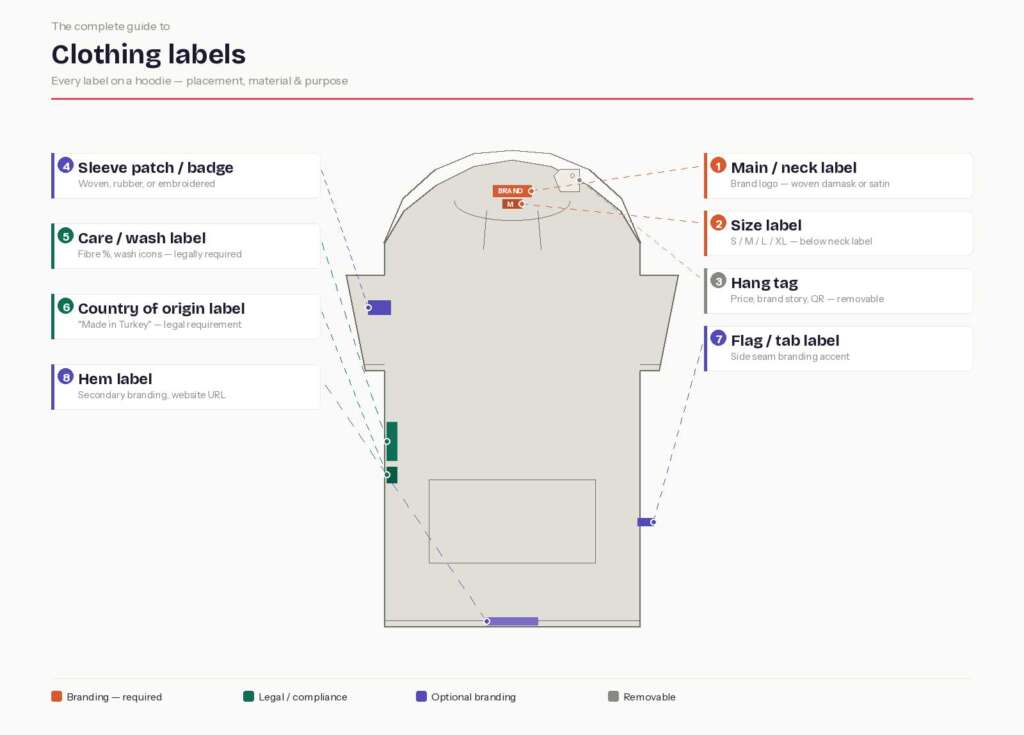
Let’s walk through every label you’ll find on a well-produced pullover hoodie, from the most visible to the most hidden.
1. Main Label (Neck Label)
What it is: The primary brand label, typically sewn at the centre back of the neck, just below the collar seam. This is your logo, your brand name — your signature on the garment.
Where it’s placed: Centre back neck, folded and sewn at both ends (centre-fold) so it lies flat against the fabric. On hoodies with a hood, it’s positioned where the hood panel meets the back panel.
Material options:
- Woven Damask — The premium choice. Threads are woven to create the design, resulting in a smooth, detailed finish that doesn’t fade or crack. Best for brands positioning as mid-range to premium. Feels high-quality to the touch.
- Woven Taffeta — Similar to Damask but with a slightly more textured weave. More affordable, still professional. Good for brands with simpler logo designs.
- Printed Satin — The design is printed (not woven) onto satin fabric. Allows full-colour, photographic-quality designs at a lower cost. Softer feel against the skin. Best for brands with complex, multi-colour logos.
- Printed Cotton — Natural feel, eco-friendly option. Works well for organic or sustainable brands. Can feel slightly rougher than satin.
- Heat Transfer (Tagless) — The label is heat-pressed directly onto the fabric, leaving no physical tag. Eliminates the “itchy tag” problem entirely. Increasingly popular in streetwear and athleisure. Brands like Nike and Champion use this method extensively.
Sizes: Standard widths are 25mm, 30mm, 40mm, or 50mm. Length depends on the fold type: centre-fold labels are typically 50–70mm when unfolded. For a clean look, the label should be proportional to the garment — a tiny 20mm label on a heavyweight oversized hoodie looks lost.
Design tips: Keep it simple. Your brand name or logo in one or two colours on a clean background. White logo on black satin is a classic. Avoid cramming too much information onto the main label — that’s what the other labels are for.
2. Size Label
What it is: A small label indicating the garment size — S, M, L, XL, or numerical equivalents.
Where it’s placed: Three common options: (a) sewn directly below the main label as a separate tag, (b) incorporated into the main label itself, or (c) printed on the inside of the care label. Option (a) gives the cleanest look and makes it easy for customers to spot the size quickly — important in retail.
Material options: Woven or printed, matching the style of your main label for consistency. Some brands use a contrasting colour (e.g., a coloured size label on a white main label) to make the size instantly visible.
Design tips: Use a font large enough to read at a glance. If you serve both EU and US markets, consider including both sizing systems. Some streetwear brands use their own custom sizing language (e.g., “1” through “5” instead of S through XL) as an additional branding element.
3. Care Label (Wash Label)
What it is: The label containing washing instructions, fibre composition, and care symbols. This is legally required in virtually every market you’ll sell in.
Where it’s placed: Inside the left side seam, typically at waist level. It’s sewn into the seam so only one edge is exposed. This keeps it hidden during wear but easily accessible when needed.
What must be included:
- Fibre composition — Listed by percentage, highest first. Example: “80% Cotton, 20% Polyester.” In the EU, this must use the exact fibre names defined in Regulation (EU) No 1007/2011.
- Care symbols — The five standard ISO symbols: washing, bleaching, drying, ironing, and professional textile care. These are standardised internationally, so one set of symbols works for all markets. In the US, written care instructions in English are required in addition to (or instead of) symbols.
- Country of origin — “Made in Turkey” or “Made in Türkiye.” Required by US FTC rules and EU customs regulations.
- Manufacturer/importer info — The EU requires a responsible economic operator to be identified. This can be a company name and country, or a registered identification number.
Material options:
- Printed Satin (most common) — Smooth, comfortable against skin, holds printed text clearly. White satin with black text is the standard.
- Printed Nylon/Taffeta — More durable and resistant to fraying. Slightly stiffer feel. Good for workwear and outerwear.
- Woven — Premium option but more expensive for the amount of text required. Usually reserved for luxury brands.
Design tips: Keep care labels as short as possible while remaining compliant. Use standard care symbols rather than written instructions where regulations allow — they’re universal and take up less space. Consider printing on both sides of the label to fit all required information without making the label excessively long. A care label that hangs 10cm below the seam looks unprofessional.
4. Country of Origin Label
What it is: A label stating where the garment was manufactured. While this information can be included on the care label, many brands choose to add it as a separate label for emphasis — especially when the origin is a selling point.
Where it’s placed: Adjacent to the care label (in the left side seam) or incorporated directly into the care label text.
Why it matters for Istanbul-produced garments: “Made in Turkey” carries significant weight in the European market. Turkey is associated with premium textile quality, ethical production, and proximity to European markets. Many brands highlight their Turkish origin as a quality indicator, in contrast to mass-produced alternatives from other regions.
Design tips: Some brands create a stylised origin label that doubles as branding — a small flag icon, a custom “Made in Istanbul” wordmark, or a label that ties the origin story into the brand narrative. This turns a legal requirement into a marketing asset.
5. Hang Tag
What it is: A removable tag attached to the garment with a string, plastic fastener, or safety pin. Hang tags are the first thing a customer touches in a retail setting and the last thing they remove before wearing.
Where it’s placed: Attached to the main neck label, the side seam, or through a buttonhole or loop. For hoodies, the most common placement is through the neck label or the care label loop.
What’s typically included:
- Brand logo and name
- Price (for retail)
- Size (redundant but helpful in retail)
- Short brand story or tagline
- Website and social media handles
- QR code linking to the brand’s website, lookbook, or care instructions
- Fabric and care summary
- Barcode or SKU (for inventory management)
Material options:
- Thick cardstock (300–400gsm) — The standard. Professional feel, easy to print. Available in matte, gloss, or textured finishes.
- Recycled/kraft paper — For eco-conscious brands. Communicates sustainability visually. Works well with simple, earthy designs.
- Fabric hang tags — Woven or printed fabric instead of paper. Premium feel, unusual, and memorable. More expensive but distinctive.
- Rubber/silicone — Tactile, durable, and waterproof. Stands out but costs significantly more. Used in outdoor and sportswear brands.
Design tips: The hang tag is your smallest billboard. Use both sides. Front: logo, tagline, hero image. Back: price, sizing, website, QR code. A well-designed hang tag makes the unboxing or purchase experience feel considered and intentional.
6. Flag Label (Tab Label)
What it is: A small folded tag that protrudes from a seam, creating a visible “flag” on the exterior of the garment. It’s a subtle but effective branding touch — think of Levi’s red tab on jeans.
Where it’s placed: Most commonly on the left side seam at hip level, but also at the bottom hem, sleeve cuff, or pocket edge. The label is folded in half and sewn into the seam so that only the folded portion is visible from the outside.
Material options:
- Woven — Most common. Clean, durable, and professional. Can include a small logo or brand initial.
- Printed — More affordable, works for full-colour designs but less durable.
- Rubber/PVC — Adds texture and a 3D element. Popular in streetwear and outdoor brands.
Size: Small — typically 10–15mm wide and 20–30mm visible length. It should be noticeable but not dominant. The best flag labels add a detail that rewards close inspection.
Design tips: Less is more. A single letter, a small symbol, or a minimalist logo works best. The flag label is about recognition, not information.
7. Hem Label
What it is: A secondary branding label sewn at the inside bottom hem of the garment. It’s a bonus touchpoint — not required, but it adds a layer of professionalism that distinguishes established brands from first-timers.
Where it’s placed: Inside the garment at the bottom hem, centred or offset. Some brands place it on the outside of the hem for visibility — a design choice that works well for oversized streetwear pieces.
What’s typically included: Brand name, website URL, or a short tagline. Some brands use it for the collection name or season identifier.
Material options: Same as the main label — woven or printed, matching the overall label family for consistency across the garment.
Design tips: Match the style of your main label. If your neck label is woven Damask on black, your hem label should be the same. Consistency across all labels signals attention to detail.
8. Sleeve Patch / Badge
What it is: An external label, patch, or badge sewn or heat-pressed onto the sleeve. This is a decorative and branding element rather than a functional one — it’s visible when worn and adds visual interest to the garment.
Where it’s placed: Upper arm area of the left or right sleeve, typically 5–10cm below the shoulder seam.
Material options:
- Woven patch — Flat, clean, professional. The most common option for fashion brands.
- Rubber/PVC/silicone patch — 3D, tactile, and eye-catching. Very popular in streetwear. Gives a technical, modern look.
- Embroidered patch — Textured and detailed. Classic look that works for heritage and workwear-inspired brands.
- Leather/faux leather patch — Premium feel. Common in outerwear and denim. Can be embossed or debossed with the brand logo.
Design tips: Sleeve patches work best when they complement the garment’s design, not compete with it. If you have a large chest graphic, a sleeve patch might be too much. If the hoodie is minimal, a well-placed sleeve badge can become the signature detail.
Label Materials Compared
| Material | Feel | Durability | Cost | Best For |
|---|---|---|---|---|
| Woven Damask | Smooth, premium | Excellent — survives hundreds of washes | Medium-High | Main labels, premium brands |
| Woven Taffeta | Slightly textured | Very good | Medium | Main labels, flag labels |
| Printed Satin | Soft, silky | Good — can fade over many washes | Low-Medium | Care labels, size labels |
| Printed Cotton | Natural, soft | Good | Low-Medium | Eco/organic brands |
| Heat Transfer | Invisible (tagless) | Good — can crack over time | Low | Athleisure, comfort-focused |
| Rubber/PVC | Tactile, 3D | Excellent | Medium-High | Streetwear patches, flag labels |
| Leather/Faux Leather | Premium, textured | Very good | High | Outerwear, denim |
Common Label Mistakes to Avoid
Using the same cheap printed label for everything. Your main brand label should be woven or at least high-quality printed. It’s the single most visible indicator of quality. Saving a few cents per label on your main brand tag will cost you in perceived value.
Forgetting legal requirements. Selling garments without proper care labels and fibre composition is not just unprofessional — it can get your products removed from online marketplaces or rejected at customs. Get this right from day one.
Making labels too big or too long. An oversized care label that hangs below the hem looks sloppy. A main label that covers the entire back of the neck is uncomfortable. Design labels that are proportional to the garment and contain only what’s necessary.
Inconsistent label design across the collection. Your main label, size label, hem label, and flag label should all look like they belong to the same family. Use the same colours, fonts, and material quality throughout. Inconsistency signals that the brand hasn’t thought things through.
Not testing label comfort. Before approving labels for bulk production, wear a sample garment for a full day. Check if any label scratches, irritates, or bunches. If a label is uncomfortable, customers will cut it out — and your branding goes in the bin.
Get Your Labels Right from Day One
Labels are the finishing touch that separates a hobby project from a real brand. They’re the details that buyers, retailers, and customers all notice — and they’re surprisingly affordable to get right when you work with a manufacturer who handles them as part of the production process.
At Custom Apparel Istanbul, we provide complete private label services: custom woven neck labels, printed care labels, hang tags, flag labels, and all the branding elements that make your collection retail-ready. We handle the design, production, and placement — so every garment that leaves our workshop looks and feels like it belongs on a shelf next to the best in the business.
Ready to design your labels? Get a free consultation →